
The Repair Bench as a Referral Channel
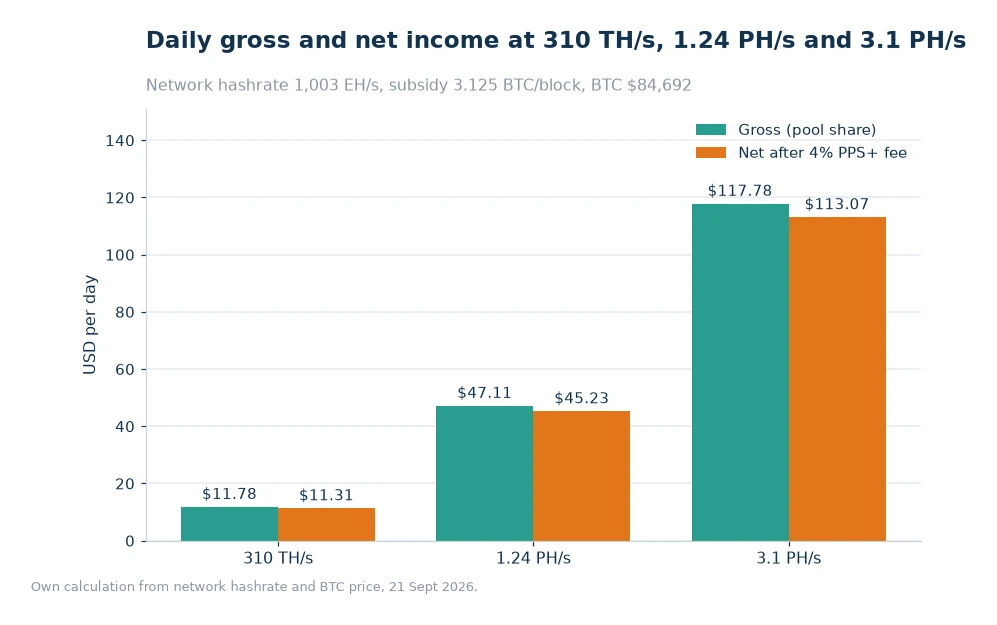
A machine at 310 TH/s earns about 0.00013908 BTC a day, $11.78 gross and $11.31 net at $84,692. When it stops, the owner does not search for a pool first; they search for someone who can look at the board. That is why a repair bench sees more new miners in a month than most marketing pages do, and why the conversation there decides where the machine points when it comes back.
Key takeaways
- Downtime has a measurable price: a day offline at 310 TH/s forgoes $11.31 of net credit.
- A repair technician is usually the first person a new miner trusts, which makes the bench a natural introduction point.
- Explain the payout schedule and the break-even power price, not the projected return.
- A favour-based channel scales badly; document the advice so it survives the technician's busy week.
Why a repair bench becomes an introduction point
Hardware fails at the worst possible moment, and the owner brings it to whoever answers the phone. At that moment the technician has three things the owner needs: a diagnosis, a time estimate, and an opinion about whether the machine is worth fixing. The first two are technical. The third is where a pool recommendation quietly happens.
That recommendation carries weight because it is not being sold. A technician who says "this board is fine, the pool configuration is what dropped your shares" has just solved a problem the owner could not name, and the owner will remember which advice was correct. The commercial relationship, if there is one, follows the useful answer rather than preceding it.
What a technician knows that a listing does not
A specification page says what a model can do. A bench knows what it does after two summers, one brownout and a bad firmware flash. That experience turns into practical guidance: which models cook their own connectors, which power supplies are worth recapping, and which faults are worth fixing versus scrapping.
It also produces an honest view of variability. Two machines of the same model can differ by several percent in efficiency after a few years, and the difference shows up in the power bill rather than the hashrate. A technician who has measured both can tell an owner which one to keep and which one to sell, which is more valuable than any generic ranking.
310 TH/s and the price of a return visit
The table prices downtime rather than repairs, because downtime is the cost owners underestimate. Each row is a different fault and the hours the machine spends offline, valued at the net credit it would have produced.
| Fault | Hours offline | BTC not earned | USD not earned |
|---|---|---|---|
| Fan replacement | 4 | 0.00002225 | $1.88 |
| Power supply swap | 8 | 0.00004450 | $3.77 |
| Hash board replacement | 24 | 0.00013352 | $11.31 |
| Waiting for a shipped board | 72 | 0.00040056 | $33.91 |
The jump from the third row to the fourth is the argument for holding spares. A board on a shelf converts a three-day outage into a one-day one and saves about $22.60 at this hashrate. That is a small number until it happens twice in a quarter.
The introduction should survive the first invoice
An owner who is introduced while their machine is on a bench will judge the recommendation by what happens in the following month. If the first credit arrives when expected and the dashboard matches the arithmetic the technician described, the introduction holds. If the owner was told a daily figure that assumed perfect uptime and a favourable price, the first quiet week undoes the goodwill.
Give the net number and the assumptions behind it. At 310 TH/s the honest line is $11.31 a day, not $11.78, and it assumes the machine hashes for the whole day at the current difficulty. Owners who understand the assumption are not surprised by a bad afternoon, and they are the ones who stay for years.
Limits of a favour-based channel
A bench can only introduce as many people as it repairs, and it repairs a finite number per month. That caps the channel at the throughput of the workshop, which is why it should never be treated as a growth engine. It is a by-product of doing the work well, and it stops the moment the work stops.
There is also a concentration risk. If the introductions all come from one person's reputation, the flow ends when that person takes a holiday, changes city, or stops answering messages. Spreading the explanations across a small team, or writing them down where customers can read them, makes the channel less dependent on a single bench.
Write the repair note
The most useful artefact a bench can produce is a one-page note per repair: what failed, what was replaced, what the machine measured before and after, and what the owner should watch. Handing that over with the machine turns a transaction into a record, and a record is what makes the next recommendation credible.
The note also protects the technician. A claim that a machine was working when it left is easier to support when the before-and-after temperatures are written down. Six lines of documentation prevent most disputes and cost about five minutes.
When the owner asks about shares
Pool choice comes up when the owner asks why their shares were rejected, why the credit was lower than expected, or whether they should switch settlement schemes. Those are the moments when a link is worth more than a lecture, and the ViaBTC Referral page is the thing to hand over rather than a verbal summary that will be misremembered.
Keep the explanation narrow. The owner needs to know that PPS+ settles the block-reward part hourly against current difficulty, that the fee part is handled on PPLNS terms, and that the two carry different posted charges. Everything else can wait until the machine is back in the rack and producing.
Worked example: the cost of a slow repair
The arithmetic converts hours into coins, then into the currency the owner actually feels.
- 450 BTC ÷ 1,003,000,000 TH/s = 0.00000044865 BTC per TH/s a day.
- 310 × 0.00000044865 = 0.00013908 BTC, or $11.78 at $84,692.
- Net after the 4% block-reward charge: 0.00013908 × 0.96 = 0.00013352 BTC, or $11.31.
- Per hour: 0.00013352 ÷ 24 = 0.00000556 BTC, or $0.47.
- Eight hours offline: 8 × 0.47 = $3.77, and 0.00004450 BTC.
- Three days waiting for a board: 72 × 0.47 = $33.91, and 0.00040056 BTC.
- A spare board on the shelf turns that into one day, saving $22.60.
Frequently asked questions
What does a day offline cost at 310 TH/s?
About $11.31, or 0.00013352 BTC at $84,692, which is the net credit the machine would have produced after the 4% charge on the subsidy portion.
Is a repair bench a good place to recommend a pool?
It can be, because the owner is already dealing with a trusted technician, but only if the advice is accurate about net figures and downtime rather than a projection that the first quiet week will contradict.
Should a technician keep spare boards?
Yes, if the same model comes through often; a spare turns a three-day wait into a one-day repair and recovers roughly $22.60 of credit per event at this hashrate.
Fix the machine, then hand over a number
The repair is the service; the number is what the owner takes away. Write the before-and-after measurements, state the net daily credit with its assumptions, and let the Miner Profitability Ranking do the model comparison when a customer asks whether their hardware is still worth running. The Profit Calculator handles the rest of the arithmetic while the solder cools.
Sources: ViaBTC referral, miner ranking and calculator pages, with chain data read 21 Sept 2026 — network hashrate 1,003 EH/s, difficulty 132.76 T, 3.125 BTC per block, 144 blocks a day, BTC $84,692. Downtime values assume the machine would otherwise have run continuously. Published 24 Oct 2026[1].