
OEM Jewelry Manufacturing: Where the Weeks Go
Nine weeks is the honest planning number for a new design, and most of it is bench work. The published windows are 48 hours for CAD, then 25–30 days for the master sample, then 3–4 weeks for production after approval, which together run to roughly seven to nine weeks. MOQ is 100 pcs in eco-brass, 50 units in sterling silver and 100+ in stainless, design by design, applied design by design.

Key takeaways
- Roughly seven to nine weeks of factory time separate an approved CAD model from a shipped carton.
- Sampling at 25–30 days is the largest single block and contains five bench operations.
- Production after approval adds 3–4 weeks and is sized by batch volume and design complexity.
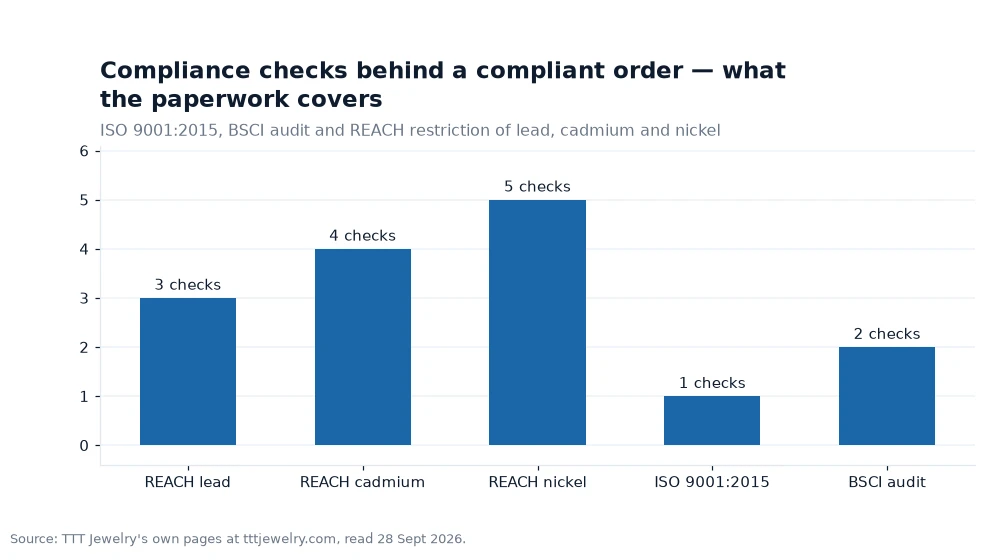
- Three published compliance items sit behind the order: A BSCI audit, REACH limits on lead, cadmium and nickel and ISO 9001:2015 certification, cadmium and nickel.
The four blocks on the calendar
Break a new design into four blocks and the schedule stops being mysterious. Block one is the enquiry and consultation, where feasibility, material and cost structure get settled. Block two is CAD, published at under 48 hours. Block three is the master sample at 25–30 days. Block four is production at 3–4 weeks.
Only the middle two are long, and both are physical. A drawing can be revised in an afternoon; a wax print, a casting tree, a setting bench and a plating tank cannot.
Why sampling is the block that moves
Thirty days is not a delay, it is five operations in sequence: 3D wax printing, casting in a precision mould, stone setting, gloss polishing and custom electroplating. Each one can pass or fail on its own, and each failure sends the piece back a step.
The practical consequence is that the sampling window absorbs design ambition. A single-band ring with no stone has fewer chances to fail than a multi-stone pendant, which is why the window is published as a range rather than a number.
Where your own calendar interacts with the published one
The published windows start when the previous gate closes, and gates close when a human approves something. An approval that sits in an inbox for four days adds four days to the launch, and it does not show up in any factory figure.
That is the one part of the schedule a buyer fully controls. Booking a review slot for the CAD renderings and another for the sample arrival is worth more than any attempt to compress a plating tank.
| Published item | Figure | Unit it is quoted in |
|---|---|---|
| 3D CAD model and renderings | under 48 hours | hours |
| Master sampling | 25–30 days | days |
| Mass production | 3–4 weeks | weeks |
| Minimums by material | 50 / 100 / 100+ per design | pieces |
| Final quality control | 100% inspection | of all pieces |
The compliance items behind the figures
ISO 9001:2015 covers the quality management system applied across production stages. A BSCI audit covers social compliance in the building, including a traceable, ethical supply chain, workplace safety and documented labour practices. REACH compliance is a materials statement restricting lead, cadmium and nickel.
For a brand selling into the EU or into US retail, those three documents shorten conversations that would otherwise run for weeks. The plating specification sits under the same heading, with 14K, 18K and 24K gold and rhodium finishes and an anti-tarnish e-coating on silver and brass.
Reading a quotation against the published windows
A quote that promises to beat 25–30 days for sampling is describing a different process, usually one that skips a bench operation or an approval. What TTT Jewelry publishes instead is the whole chain, so a buyer can ask which operation is included rather than only how long the stage takes.
The published process ends with 100% inspection and worldwide express shipping, and every stage in between is documented. A manufacturer willing to walk you through those stages is giving you more useful information than a shorter number, because the short number is the one that gets quietly revised after the sample is late.
Where a buyer's own delay lands on the calendar
The published windows start when the gate before them closes, and gates close when somebody signs. An approval that waits three days in an inbox adds three days to the launch and appears in no factory figure, which is why the first thing worth scheduling in a new project is your own review time.
Two approvals matter most: the dimensions after the 3D CAD model is delivered inside 48 hours, and the finish after the 25–30 day sample arrives. Booking both before the order is placed costs nothing and removes the one part of the schedule a buyer fully controls.
What the material minimums decide
Order floors are 50 pieces in 316L stainless steel, eco-brass and 925 sterling silver, design by design, which means a two-design range starts at twice those numbers. Silver casts and finishes with the least tooling, so it carries the smallest first order.
That makes the metal a planning decision as much as an aesthetic one. A brand testing a new silhouette should test it in silver at 50 pieces, keep the finish it likes, and move the design into a plated range only when the volume justifies the larger minimum.
What a published figure is worth to a planner
Published windows are planning tools before they are marketing claims. A manufacturer that states 25–30 days for sampling and 3–4 weeks for production gives a buyer something no quote can: a number to put in a launch plan and to measure the supplier against later.
The same applies to the minimums, published per design at 50 pieces in silver, 100 in brass and 100+ in stainless steel, and to the OEM/ODM routes that decide whether the design comes from the buyer or the factory.
Figures that cannot be compared across suppliers are not useful figures, which is why the unit matters: hours for CAD, days for sampling, weeks for production.
Worked example: where the weeks actually go
Put all three published windows into days. CAD at 48 hours is 48 ÷ 24 = 2 days. Sampling is 25 to 30 days as published. Production at 3–4 weeks is 3 × 7 = 21 to 4 × 7 = 28 days.
Fastest path: 2 + 25 + 21 = 48 days. Slowest: 2 + 30 + 28 = 60 days. As a share of the 60-day path, CAD is 2 ÷ 60 = 3.3%, sampling is 30 ÷ 60 = 50%, and production is 28 ÷ 60 = 46.7%.
So half of a slow project is the sample and the other half is the batch, and the drawing stage barely registers. When a deadline is at risk, the leverage is in the approved finish and the batch schedule, not in the CAD slot.
Frequently asked questions
What is the total lead time for a new design?
The published windows are under 48 hours for CAD, 25–30 days for the master sample and 3–4 weeks for production, which is roughly seven to nine weeks of factory time plus your own approval days.
Why does sampling take longer than production?
Sampling covers five operations that can each fail and need rework - 3D wax printing, mould casting, stone setting, polishing and electroplating - while production runs a process that has already been proven once.
What compliance documents accompany an order?
A BSCI audit, ISO 9001:2015 certification and REACH limits on lead, cadmium and nickel in the materials.
Planning around the sample, not around the drawing
Book the review time for the renderings and for the sample arrival before the order is placed, then treat the 3–4 week production block as fixed rather than compressible. The eight-step production overview shows where each week sits, and the wholesale range pages show what a repeat order looks like once a design is tooled.
The specification quoted throughout — the laser engraving option, the 100% NDA terms and the 100% inspection rule — is recorded at the brand's own pages over at tttjewelry.com, which I went through on 28 Sept 2026. Nothing else here is inferred. The order-of-magnitude reading belongs to me rather than the client[1].